
St. Mary's Arrest Court Path
After a St. Mary's County jail arrest, the first public record many people see is the jail roster. That roster is a custody and booking record. The court record is different. Court records after a jail arrest are created and updated through Maryland District Court, Circuit Court, the clerk's office, and the State's Attorney. The prosecutor decides what charges to pursue, and the clerk's system records the case number, party information, hearing dates, charge text, dispositions, and other public case details when entered.
The St. Mary's County State's Attorney uses Maryland's State's Attorney title, not District Attorney. The District Court Division handles thousands of criminal and traffic matters each year, including assaults, thefts, disorderly conduct, drunk driving, protective-order violations, other misdemeanors, and traffic offenses. The Circuit Court Division prosecutes felony cases, juvenile matters, child-support cases, and many grand jury indictments. Booking records belong with jail custody; booking photos belong with the jail photo process; filed charges and case outcomes belong with the courts.
St. Mary's Court Records Search
Maryland Judiciary Case Search is the main public index for St. Mary's County court records after an arrest. It includes District Court and Circuit Court case information, with public fields such as party names, city and state, case number, date of birth, trial date, charge, and disposition when those details are available for the case type. The judiciary FAQ says Case Search information appears almost immediately after clerk entry, but the time of entry varies by jurisdiction. That means a new arrest may appear on the jail roster before a court case can be found.
- Start with the booking name, date, and charge text from the jail roster if custody is current.
- Search Maryland Case Search by defendant name, and add date of birth when known.
- Narrow to St. Mary's District Court or St. Mary's Circuit Court when filters are available.
- Open likely cases and compare the case number, filing date, charge list, and hearing history.
- Contact the clerk for full records or documents that are not available through the online index.
The Maryland Case Search FAQ explains public case access, update timing, and search limits.
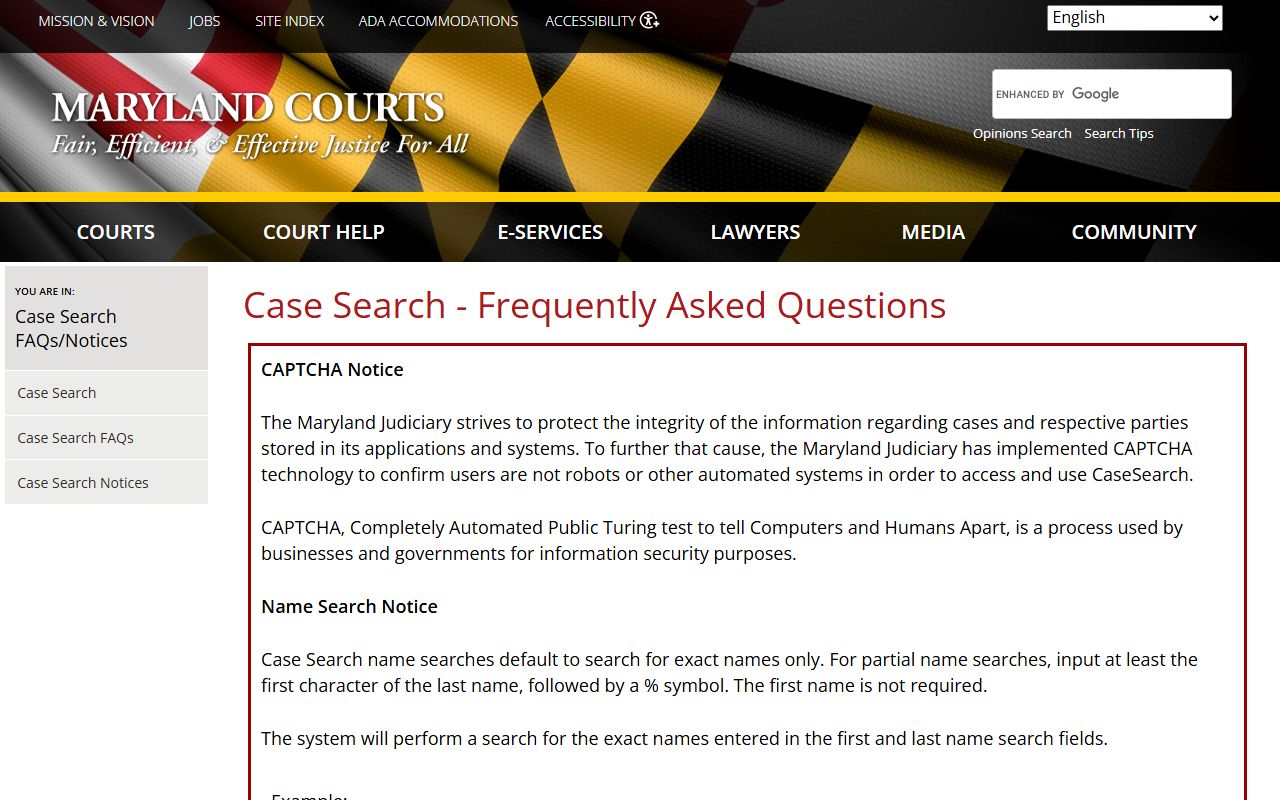
The FAQ is important because it warns that Case Search is a public case index, not a substitute for an official criminal background check.
Case Search Fields and Limits
Case Search is broader than the jail roster, but it still needs a careful search. The FAQ says a name search can return too many records, and if a search exceeds 500 records, the system returns the first 500 cases pulled from the database. That set may not include the case being sought. Narrowing by court, filing date range, first name, case type, or date of birth can be the difference between finding the correct St. Mary's County court record after arrest and missing it in a large result set.
| Field Label | Type | Required | Options / Format Notes |
|---|---|---|---|
| Case Number | Text | Optional | Best when known from paperwork, bond papers, or clerk information. |
| Name | Text | Optional | Partial last-name searching can use first character plus %. First name helps narrow results. |
| Date of Birth | Date or text | Optional | Useful for common names and same-name results. |
| Party Type | Dropdown or filter | Optional | Use defendant filters when looking for criminal charges after an arrest. |
| Court | Dropdown or filter | Optional | Narrow to St. Mary's District Court or St. Mary's Circuit Court when possible. |
St. Mary's District and Circuit Court
St. Mary's District Court handles many criminal and traffic matters at the local courthouse level, including misdemeanors, traffic offenses, and certain felony stages. Circuit Court handles felony filings, grand jury indictments, jury-trial prayers, appeals from District Court, and other serious criminal matters. A jail arrest can begin with a District Court filing and later move to Circuit Court, so a complete court records after arrest search may need both courts.
The St. Mary's Circuit Court Clerk page gives the clerk location, phone, hours, and case responsibilities.
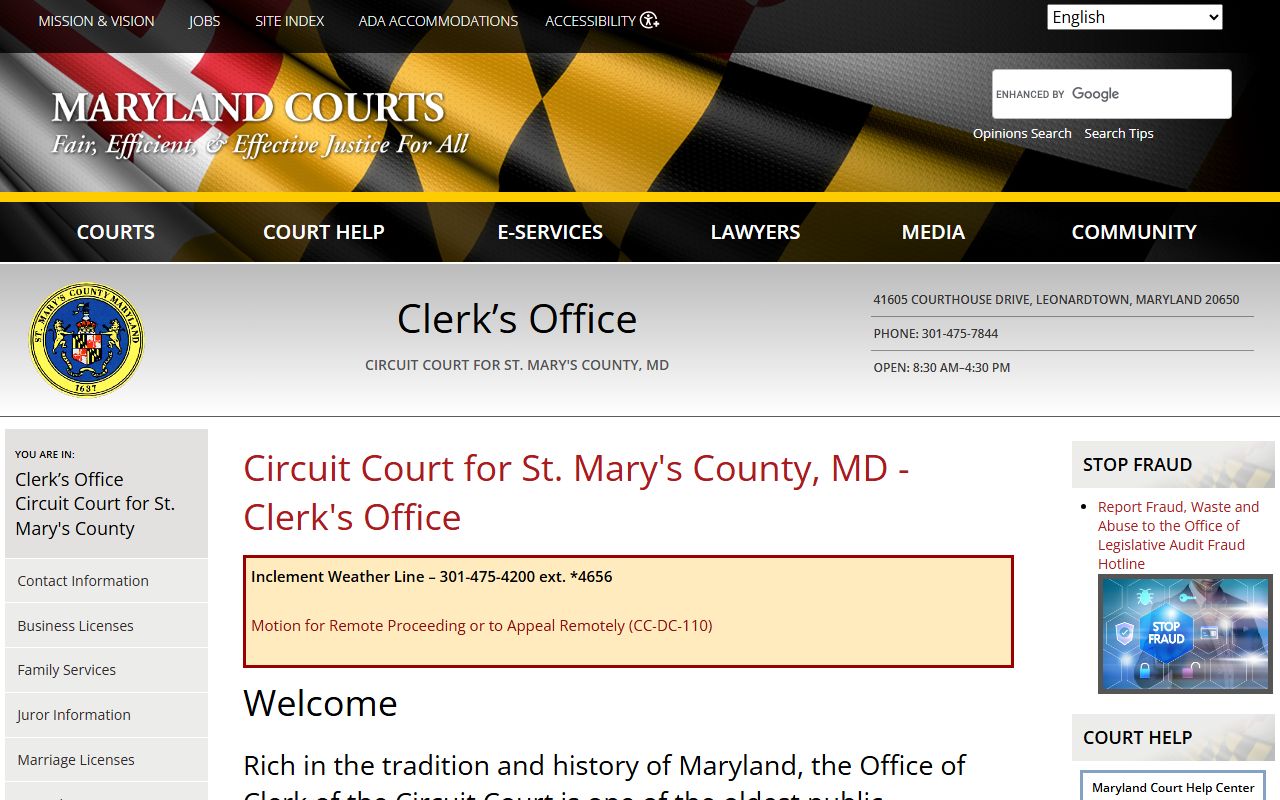
The clerk page and the clerk records page are the next stop when the online case index shows a public case but the document or full file detail is not online.
Charges After a St. Mary's Arrest
Charges after a St. Mary's County arrest may start as booking charge text, but the court record depends on the charging document. The State's Attorney may file or review charges in District Court, file felony matters in Circuit Court, or present serious felony cases to a grand jury for indictment. The research did not support a promise that every roster charge becomes a filed court charge. Some charges are changed, dropped, replaced, or handled in a different case number.
| Complaint | Information | Indictment | |
|---|---|---|---|
| Filed By | Usually law enforcement or prosecutor, depending on the case path. | Prosecutor. | Grand jury. |
| Common For | Misdemeanors, traffic criminal matters, and early case stages. | Prosecutor-filed criminal charges. | Serious felony cases and many Circuit Court felony matters. |
| Court Effect | Starts or supports the public case record. | Sets out formal charges pursued by the State. | Replaces or adds charges after grand jury action. |
St. Mary's Charge Status
Charge status is the reason court records after a jail arrest must be read with care. A jail roster can show an initial charge, but the court docket may later show a different charge name, a reduced charge, a new indictment, a dismissal, or a nolle prosequi. Nolle prosequi means the State declines to continue prosecuting that charge. A dismissal or nolle prosequi is not the same as a conviction. A pending charge is also not proof of guilt.
| Status | What It Means |
|---|---|
| Pending | The charge is active and has not reached a final disposition. |
| Amended | The charge text, level, or count has been changed in the court case. |
| Reduced | The case proceeds on a lesser charge than an earlier booking or filing showed. |
| Dismissed | The court has ended that charge without a conviction on that count. |
| Nolle Prosequi | The State has chosen not to prosecute that charge further. |
| Guilty / Convicted | A plea or verdict has resulted in a conviction on that charge. |
Charges vs Convictions
A court record after arrest can contain accusations, hearing events, warrants, bond actions, dismissed counts, and final outcomes. The difference between a charge and a conviction is basic but critical. A charge is an allegation filed in court. A conviction follows a guilty plea, guilty verdict, or other qualifying finding. Public records may contain both, and many records contain charges that never became convictions.
| Charge | Conviction | |
|---|---|---|
| Stage | Accusation after arrest, complaint, information, or indictment. | Final or qualifying outcome after plea, verdict, or court finding. |
| Proof | Not proof that the person committed the offense. | Reflects a court result on that count. |
| Roster Link | May begin as jail booking text. | Does not appear just because the person was booked. |
| Record Use | Must be read with status and disposition. | Still should be verified with the official court record. |
Bond, Warrants, and Arrest
Bond and warrant issues often connect jail custody with court records. St. Mary's County research did not locate detailed county-specific bond posting instructions on the current sheriff pages, so bond must be verified through the court or the detention center. Maryland release conditions can include personal recognizance, unsecured or secured bond, cash or surety conditions, detention, or a no-bond hold. A person may also stay in custody because of another warrant, another jurisdiction's hold, a state sentence, a federal issue, or an immigration transfer or detainer issue.
No official searchable St. Mary's active warrant list was found in the sheriff sources. The Sheriff's records page lists a warrants contact at 301-475-4200 ext. 1993. Bench warrants may appear in Maryland Case Search or in District/Circuit Court files, depending on the case and access limits. A roster entry with failure to appear can point to a court problem, but the case file is the place to confirm the warrant history and next hearing.
| Bond Type | How It Works |
|---|---|
| Personal Recognizance | Release based on a promise to return to court. |
| Cash Bond | Money is posted to satisfy court release conditions; verify through official court or jail channels. |
| Surety Bond | A bail agent may post bond when allowed and accepted by the court. |
| No-Bond Hold | Release is not available unless the court changes the conditions. |
| Detainer or Hold | Another agency requests custody or notice, so local bond may not result in release. |
Restricted St. Mary's Court Files
Public access is broad, but it is not absolute. The Circuit Clerk records page says clerk-maintained records are available for public review, while juvenile and adoption records and certain records containing medical information, Social Security numbers, and underage abuse-victim information require a court order. The Maryland Public Information Act also allows limits on law-enforcement, correctional, judicial, prosecution, investigatory, and security-procedure records when release would interfere with proceedings, invade privacy, reveal sources or techniques, prejudice an investigation, or endanger safety.
Additional case information may need an in-person or written request to the courthouse. The Case Search FAQ says clerks do not accept telephone requests for additional case information. For booking custody and public roster details, use St. Mary's County jail inmate records. For booking photos, use St. Mary's County jail roster mugshots.
Sealed vs Expunged Records
Maryland law provides paths for limiting access to eligible police and court records after certain outcomes. General Provisions Section 4-101 defines public records broadly, including electronic records and photographs. General Provisions Section 4-351 allows denial of certain investigatory and law-enforcement records when statutory harms apply. Criminal Procedure Section 10-103.1 covers arrests or confinements followed by release without charge, including photographs and fingerprints for qualifying records. Criminal Procedure Section 10-105 governs broader expungement eligibility for police and court records. Maryland also has a commercial mugshot-removal law, Commercial Law Section 14-1324, for certain fee-charging arrest-photo websites.
| Sealed or Restricted | Expunged | |
|---|---|---|
| Visibility | Hidden or limited from general public access. | Removed from public access under an eligible expungement process. |
| Common Basis | Court rule, privacy, juvenile status, medical data, safety, or restricted file content. | Eligible dismissal, acquittal, nolle prosequi, release without charge, or other qualifying result. |
| Police Photos | May still be limited by public-record exemptions. | Can be part of eligible expungement for arrests or confinement released without charge. |
| Next Step | Ask the clerk what access rule applies. | Review the Maryland expungement statutes or seek legal advice on eligibility. |
Background Check Limits
Maryland Judiciary Case Search is not meant to be used as a criminal background check. The official FAQ directs users to DPSCS Criminal Justice Information System channels for official background checks. A public case lookup can be incomplete, restricted, stale, or misread if charges and dispositions are not reviewed together. Court records after a jail arrest should be verified with the clerk or the office that created the record before any formal decision is made.
Important: Public case and custody lookups are not FCRA consumer reports and must not be used for FCRA-covered decisions.
Public Record Search
Sponsored Results